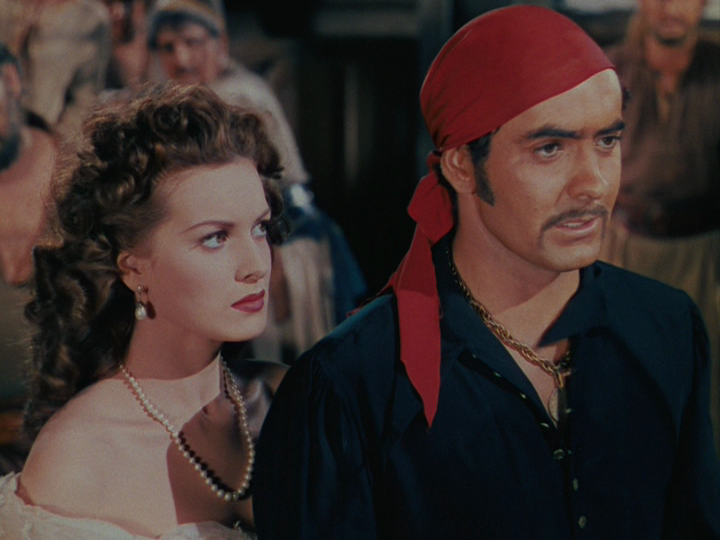
 This post is my contribution to the "Fabulous Films of the 1940s Blogathon," sponsored by the Classic Movie Blog Association. For a full list of excellent entries from the other blog participants, please click here.  "The grand age of the adventure epic gave to the American people, as to people all over the world, an image of grandeur and glitter and flair which our own eccentrically stable country could barely approach. Most importantly, it gave a sense of grace. Grace - the ability to make the difficult look easy and the simple look profound - was the stylistic hallmark of the swashbuckler and the gentleman adventurer." (1) 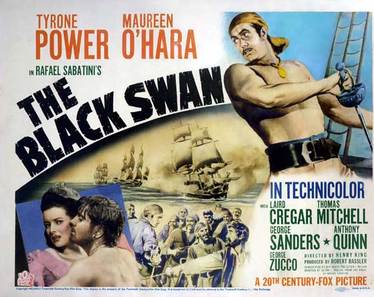 I love a good swashbuckler. The swashbuckler is a particular subgenre of the period adventure film, or costume epic. It's a particularly fun little corner of the movie universe, where good always triumphs over evil; disagreements are settled with swordplay and, if at all possible, accompanied by a witty verbal riposte; where heroes are dashing and villains hissable; and where historical accuracy adds plenty of background color but never gets in the way of a ripping good yarn. Though swashbucklers have always been made by the major studios, the genre enjoyed three distinct heydays: the 1920s, when Douglas Fairbanks Sr. came bounding onto the scene; the mid-to-late 1930s, when Errol Flynn and his cheeky grin ruled the box office; and a late blossoming in the 1950s, when studios used the color and pageantry of the form to liven up their new widescreen processes and lure audiences back from the upstart medium of television. 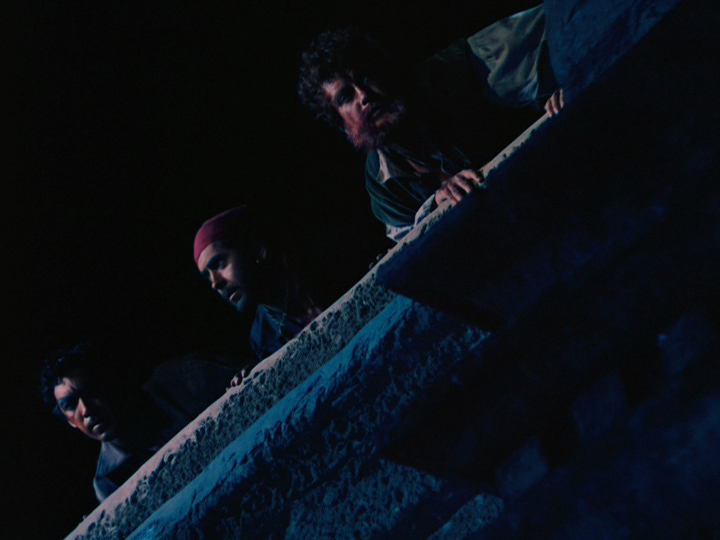 Swashbucklers come in many flavors: the pirate movie (Captain Blood, The Sea Hawk), tales of knights errant and damsels faire (The Black Shield of Falworth, Prince Valiant), Arabian fantasies, replete with desert sheiks, veiled maidens and clashing scimatars (The Desert Hawk, Ali Baba and his Forty Thieves), the Robin Hood / Zorro "steal from the rich" school, among others - all served up with sweep, panache and sumptuous production values by the Hollywood studio system. Some maintain that swashbucklers are still made even today (citing the Pirates of the Carribean franchise as one example), but really, the swashbuckler could only really exist in the more innocent age of classic Hollywood, before reflexive irony and eye-rolling self-awareness became the norm. The 1940s, while not overburdened by the genre, certainly had more than their fair share of memorable swashbucklers. The Black Swan, in all its Technicolor glory, is one of the most beautiful to behold. 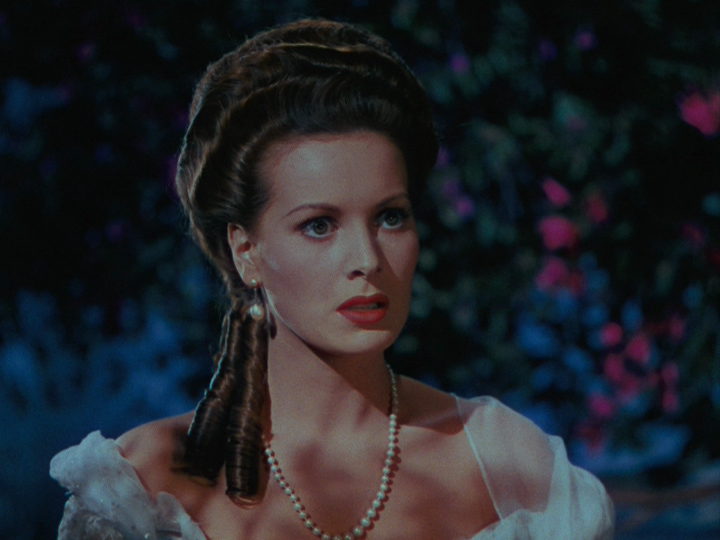 22-year-old Maureen O'Hara, a beauty born for Technicolor. All the elements of a good swashbuckler are in clear evidence here, starting with the de rigueur title card: 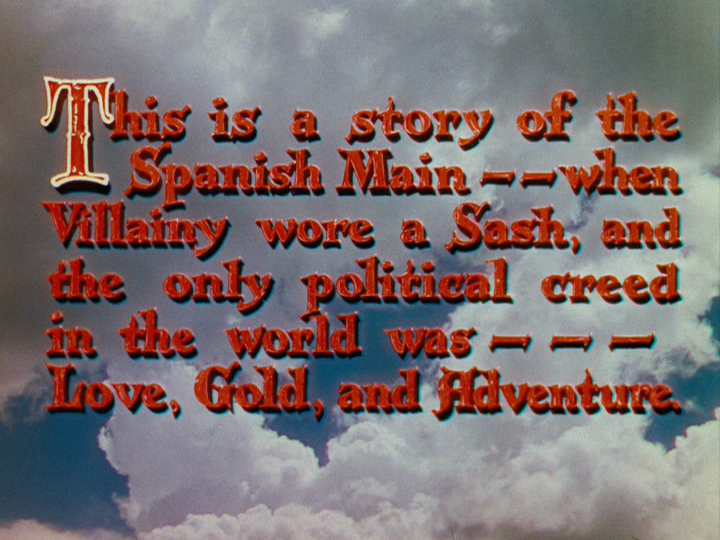 Pirates ransack Jamaica, under the joint leadership of Jamie Waring (Tyrone Power), captain of the Revenge, and Billy Leech (George Sanders), captain of the Black Swan. Before they can make their escape and enjoy their booty, government troops arrive and drive the pirates from the island. Jamie is captured and put to the rack to glean information on the whereabouts of Henry Morgan, the infamous pirate leader and Jamie's close confederate, whom he thought hanged by the magistrates in London. Before long, Jamie is rescued by his loyal friend Tommy Blue (Thomas Mitchell) and promptly throws the governor of Jamaica, Lord Denby (George Zucco), in the dungeon. He soon encounters the governor's fiery beauty of a daughter, Lady Margaret (Maureen O'Hara), and the sparks fly.
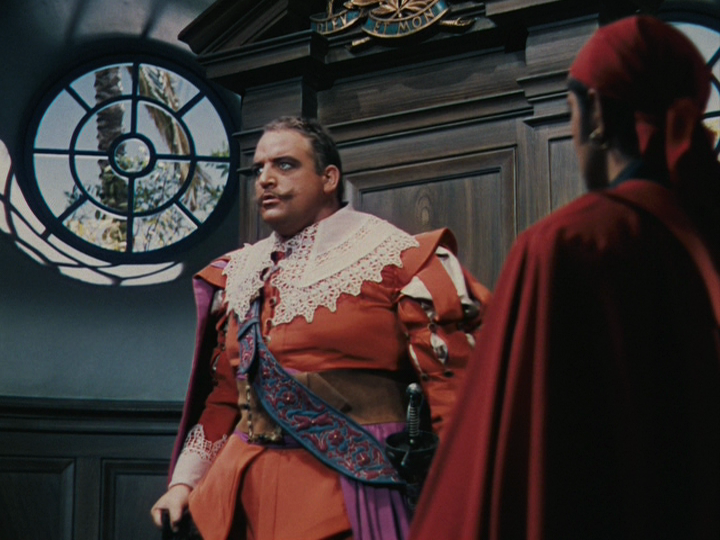
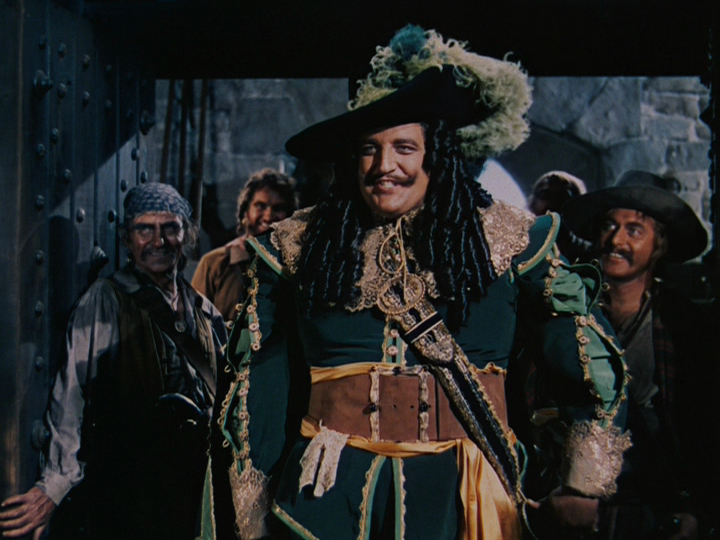 The larger-than-life Laird Cregar as Capt. Henry Morgan. The larger-than-life Laird Cregar as Capt. Henry Morgan. Smitten, Jamie throws Lady Margaret over one shoulder and is about to cart her off to his ship when he sees Captain Morgan (Laird Cregar) himself stride through the palace doors. Turns out Morgan has been pardoned by the British government and sent back as the new governor of Jamaica, tasked with cleaning up the Spanish Main and ridding the shipping lanes of the depredations of his old pirate cronies. Morgan wants his old brethren to strike the colors for England and prey only on French ships. Captain Leech wants no part of this and heads off to raid the rich port town of Maracaibo. Jamie and Tommy stay loyal to Morgan and move into the governor's quarters, Jamie claiming Lady Margaret's old room for himself. Morgan quickly finds the political wrangling of the Jamaican parliament more troublesome than his freebooter days. (Morgan: "I wish my nature hadn't changed. I'd have made that assembly walk the plank." Jamie: "You can't go wrong drowning politicians, Henry."). In the meantime, Jamie pursues Margaret, but she spurns his advances.
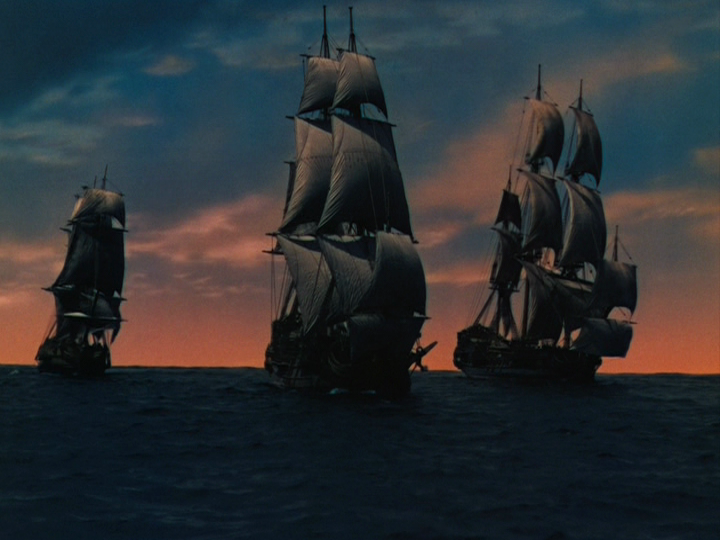
 Roger Ingram, left, as snooty schemer Ashley. Roger Ingram, left, as snooty schemer Ashley. Lady Margaret is engaged to foppish Edward Ashley (Roger Ingram) but is unaware that he's made a deal with Leech to betray the shipping routes and movements of His Majesty's fleet, partly to line his own coffers and partly to discredit Morgan in the Jamaican assembly. As the assembly votes to impeach Morgan and remove him from office, Jamie takes drastic steps and kidnaps Margaret, hoping not only to woo the icy lady but to stall Morgan's impeachment. Intercepted by Leech and his men and vastly outgunned, Jamie pretends to join Leech in hopes of turning the tables on him later, passing Margaret off as his wife. As a sign of good faith, the cautious Leech demands that Jamie and his blushing new “bride” sail with him on the Black Swan. Leech grows suspicious over the couple's chaste sleeping arrangements, however, and snatches Margaret, leaving Jamie trussed up on the Swan, while he sails Jamie's ship Revenge into Maracaibo harbor for a surprise assault. Can Jamie escape in time to foil Leech's plans and rescue the woman he loves? 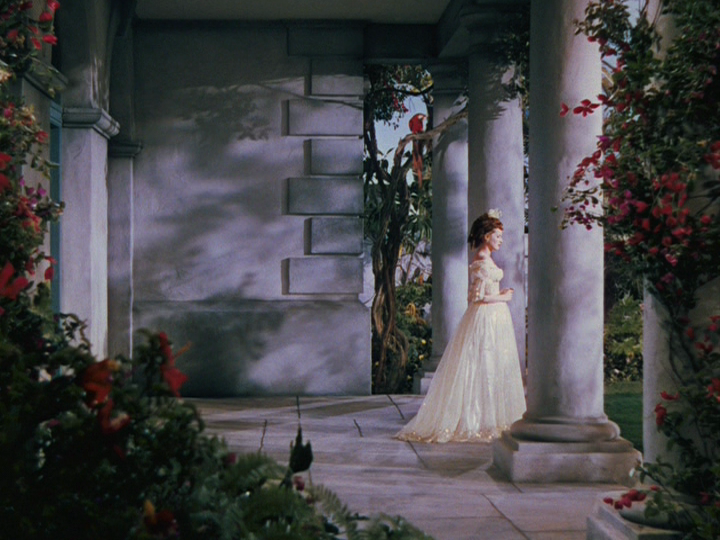 Many of the Technicolor compositions resemble the paintings of N.C. Wyeth. 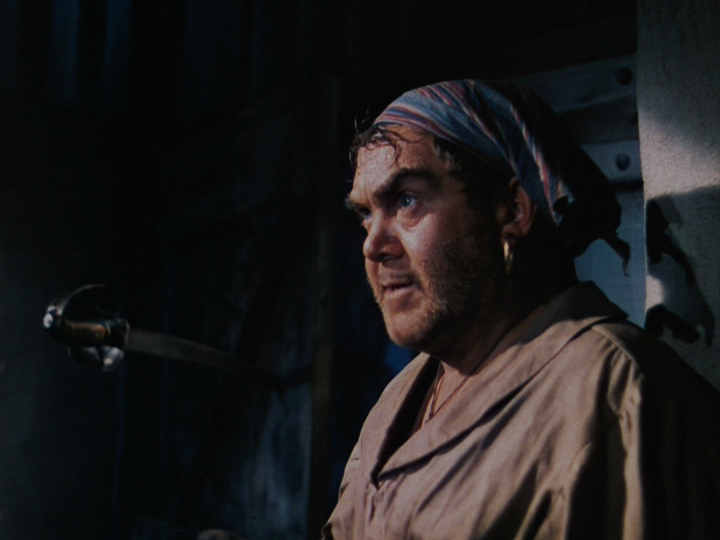 Ever-reliable character actor Thomas Mitchell as Tommy Blue. The Black Swan is not the most action packed of swashbucklers, but it's certainly one of the glossiest, beautifully produced by all the myriad, masterful craftsmen employed by 20th Century Fox at the time. Director Henry King keeps the plot moving quickly and the script, by the legendary Ben Hecht and Seeton I. Miller (loosely based on the Rafael Sabatini novel), gives the dialogue a full-blooded poetry. There's a lush score from Alfred Newman and the 3-strip Technicolor cinematography by Leon Shamroy is simply gorgeous. Special care was taken with the effects and model work. (All the full view scenes of ships sailing the Spanish Main were models, though to call them miniatures would be misleading, as they were a full 18 feet long, with 16-foot-tall masts. Their increased size helped make their movement through the waters of the Fox tank look more realistic). 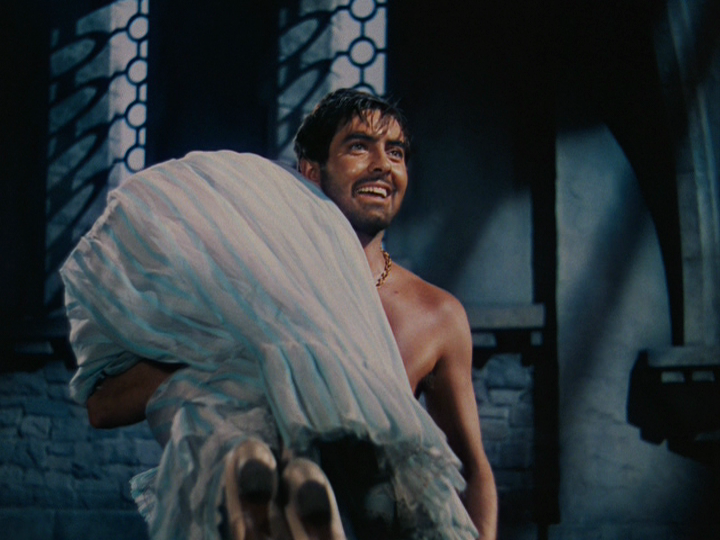 Tyrone Power lacked the robust physicality of Errol Flynn, but stacked up an impressive number of swashbuckling parts in his relatively brief career, most notably The Mark of Zorro from 1941. The Black Swan isn't an out-and-out classic like Zorro, but is still pretty dang good in its own right. Power cuts a terribly handsome, dashing figure as a pirate captain, and has fun with the more unsavory, roguish elements of his character - though of course, in tried-and-true Hollywood fashion, the ultimate bad boy is eventually redeemed and ennobled by his love for a worthy woman. Power himself apparently tired of his heroic swashbuckler roles, and felt somewhat constrained by the demands of the studio and his public to keep making them. He much preferred later, juicier parts like those in Nightmare Alley and Witness for the Prosecution that demanded a more complex kind of acting. However, I don't think his work in these period adventure films should be undervalued. It's not at all easy to bring these sorts of noble hero roles to life in an unselfconscious way. Villains are always the most colorful parts, and it's often hard to avoid coming across as bland and stiff when one plays the stalwart hero. Like Flynn, Power brought just the right balance of saucy, devil-may-care attitude and suave confidence to such roles. He made it all look easy, and that's a rare and underappreciated skill. Sadly, another historical spectacle proved to be Power's last. According to Tony Thomas' Cads an Cavaliers: The Film Adventurers: Tyrone Power died while making Solomon and Sheba on location in Spain in 1958, and the film was largely the cause of his death. He was aware of his heart condition; in fact it was shortly before leaving for Spain that he did a film for the American Heart Association in which he warned of the dangers of exertion and said "time is the most precious thing we have." Solomon and Sheba was the kind of film that demanded physical effort, a costume epic with much action; Power was the kind of actor loathe to let a double do what he felt he could do himself. On the afternoon of November 15, he filmed a scene with George Sanders as the villain, in which the two performed a duel with broadswords. The scene was incomplete when Power asked to stop and went to his dressing room complaining of pains in his arms and chest. An hour later he died. He was forty-four. (2) 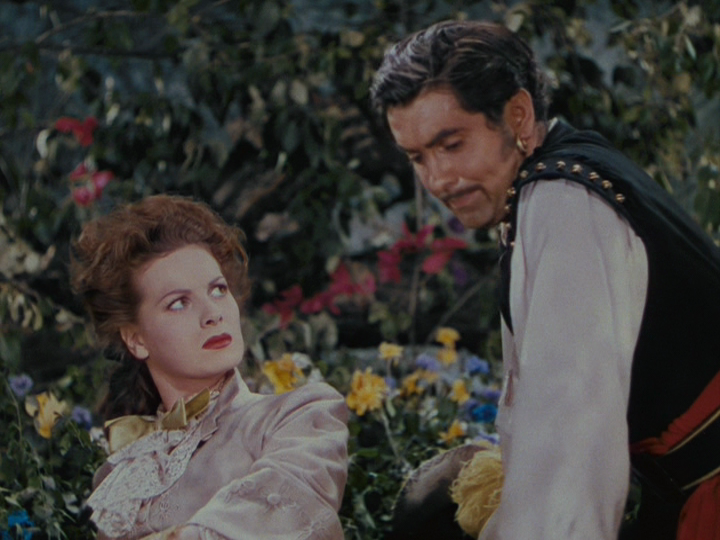 Maureen O'Hara was already quite a star by this point in her career, and though young, her spirited, fire-and-ice persona is in full flower here. With her porcelain skin, auburn hair and wonderful figure, along with a razor tongue, strong temper, and regal manner, O'Hara possessed the perfect amount of strength and beauty to stand toe-to-toe with larger than life actors like Power and (especially) John Wayne. She also carried herself with a certain hauteur which is well-suited to her character here, a privileged governor's daughter who is above fraternizing with a lowly dog of a pirate. In real life, Ms. O'Hara was far from a snob when it came to accepting film roles. On the commentary track, she confesses to film historian Rudy Belmer a true fondness for adventure films, and she made plenty of good ones in her career, including The Spanish Main, Flame of Araby (with Jeff Chandler), Bagdad, Against All Flags (with an aging but still game Errol Flynn) - and even wielded a sword herself, as the daughter of musketeer Athos in At Sword’s Point (with Cornel Wilde). O'Hara was a dab hand with a sword, with noted swordplay coordinator Fred Cavens reportedly naming her the best of all Hollywood's lady fencers. O'Hara and Power have great chemistry together in The Black Swan, yet only had a chance to co-star once more, in John Ford's The Long Gray Line (1955). 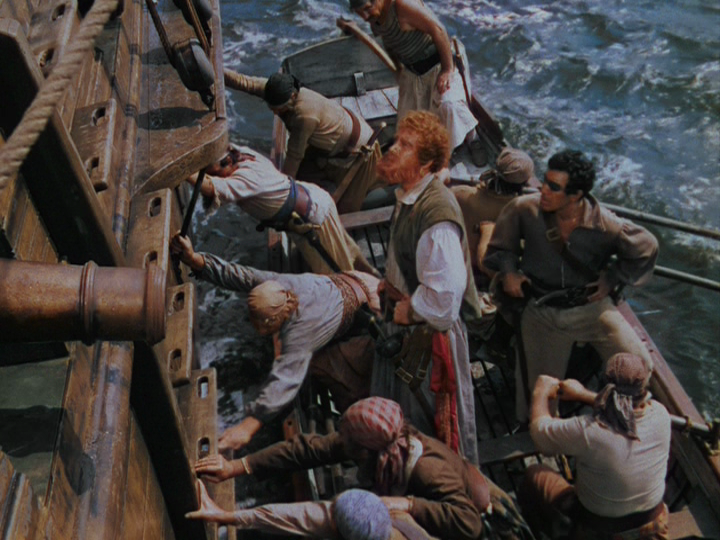
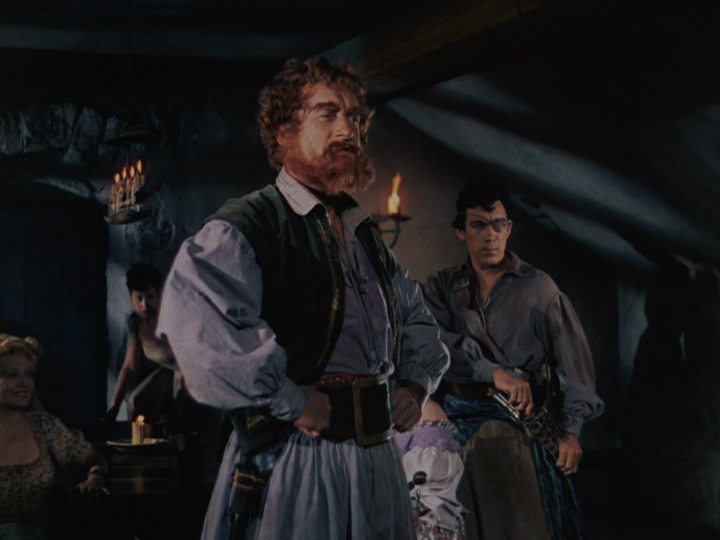
The supporting cast is, if anything, even stronger than the leads. Thomas Mitchell might seem an odd choice at first glance to play a buccaneer, but he tackles the role of Tommy Blue with gusto. Anthony Quinn isn’t given much to do except glower behind an eyepatch and grin like a shark, but is an effective presence nonetheless. George Zucco and Roger Ingram bring the right degree of acid-tongued contempt to their lordly roles. And it’s a real treat to see the usually suave and dapper George Sanders playing a rough and tumble pirate. (Not one to overexert himself, Sanders apparently took the part on the proviso that he wore a beard to make it easier for him to be doubled in the fencing scenes.) 1942 was a banner year for Sanders, as he starred in a full nine (!) films, not only playing villains against Power in Swan and Son of Fury, but 3 Falcon mystery programmers (A Date with the Falcon, The Falcon Takes Over and The Falcon's Brother), roles in Tales of Manhattan, Her Cardboard Lover and Quiet Please: Murder, as well as scoring the lead as a surrogate Paul Gaugin in The Moon and Sixpence. As good as Power, O'Hara and the rest of the cast are, the one who truly steals the show is Laird Cregar as Henry Morgan. At 6‘ 3”, Cregar gives a literally towering performance, his deep, booming voice and large stature bringing a real authority to the part. When he's on screen, he's mesmerizing. A unique and extremely talented actor, Cregar died tragically young at age 31, only a few years after completing work on The Black Swan. His premature death surely robbed cinemagoers of many more wonderful performances yet to come. 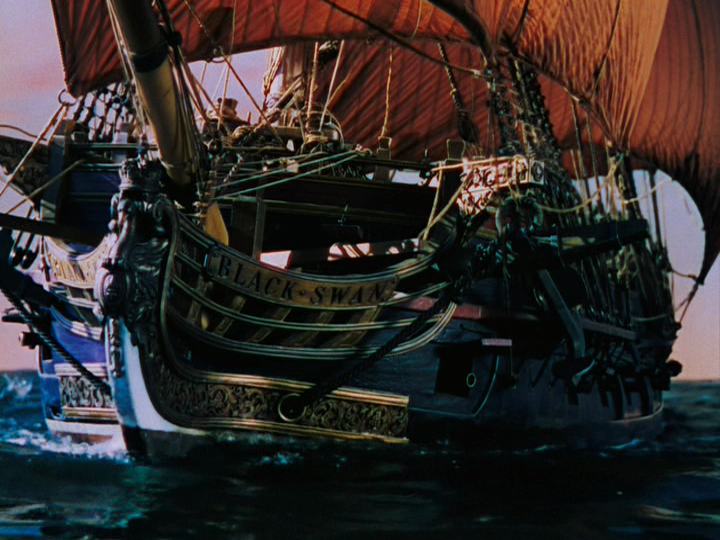 The Black Swan does have a few plot holes. For example, we never see the treacherous Ashley get his just desserts, despite his actions having caused hundreds of deaths and the loss to the Crown of more than a million pounds in gold and sterling. It's also never made clear if his skullduggery had the support of Lord Denby, such is Denby's hatred of Morgan (though the latter is probably an unlikely scenario). In addition, modern audiences may find it a little hard to fully root for Power’s character, at least in the beginning. In reality, pirates were (and are) the scum of the sea, murdering, pillaging, raping criminals, and the film brings about as much of this rough edge to the screen as the Hays Code would allow. It’s clear that Jamie has taken more than his fair share of lives, has pillaged and ransacked with the worst of them, and had his way with many of the women he captured (who, it’s implied, came to enjoy it). He does seem to have some loyalty to his home country of England, preferring to raid the French if at all possible. To his credit, Power doesn’t downplay the more base and lusty side of Jamie’s nature. Some of this is mitigated as he goes on to renounce his piratical activities and behave in a more civilized, gentlemanly fashion by the romantic fade-out. There’s also a shortage of swordplay for a swashbuckler, in my opinion, but the finale delivers the goods, as Power, Tommy and the rest of the Revenge's crew battle it out with Leech’s men, cannons boom, cutlasses and cudgels fly, and Power and Sanders face off in one-on-one combat. Their swordfight isn’t in the same league as the excellent one between Power and Rathbone in The Mark of Zorro, and features that annoying sped-up effect so common to fighting scenes of this era, but overall it's jolly good stuff, and caps the movie off with a rousing flourish. Tyrone Power would go on to further costume epics, such as Captain From Castile, Prince of Foxes and The Black Rose, yet none of these were able to match the sheer swagger, splendor or pictorial beauty of The Black Swan. 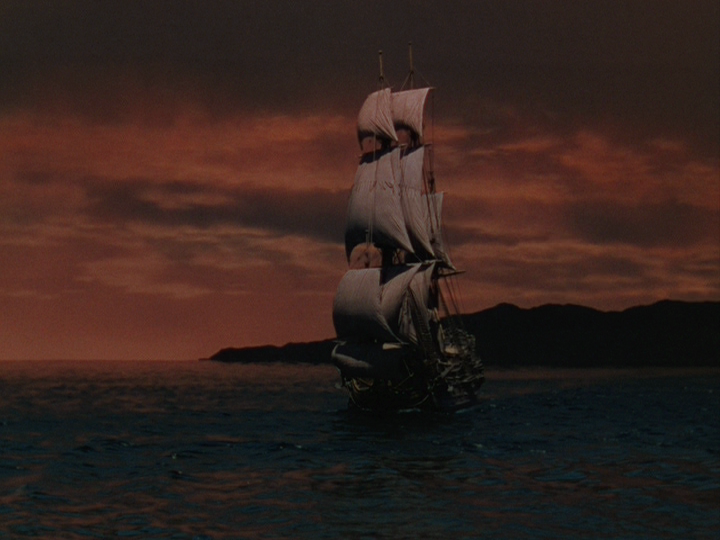 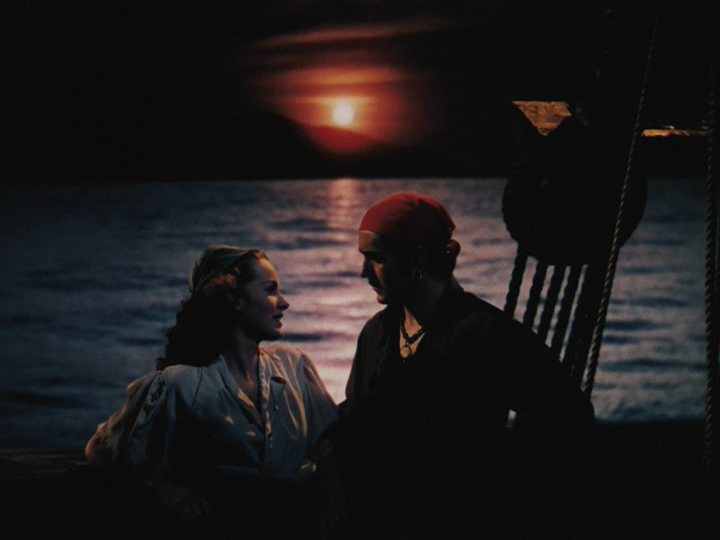 Acknowledgements: (1) excerpted from Thaddeus Tuleja's introduction to Cads and Cavaliers: The Film Adventurers by Tony Thomas, published by A.S. Barnes and Company, 1973. (2) is by Thomas, also quoted from the same source. DVD Note: The Black Swan is part of Fox's "Studio Classics" line, and looks great on DVD (one can only imagine the splendor of an eventual Blu-Ray release, should we be so lucky). Extras include a typically informative commentary track hosted by Rudy Belmer, with frequent contributions from Maureen O'Hara.
39 Comments
2/21/2013 02:10:44 pm
Though not an expert on or huge fan of the swashbuckler genre, I love "The Black Swan." In glorious Technicolor it is a gorgeous sight to behold, as are Tyrone Power (who would have heard "Jamie boy" three times from me sooner than he did from his co-star) and Maureen O'Hara. Their chemistry crackles and adds much to make this high seas adventure appeal to me. Enjoyed Power's tongue-in-cheek approach. Always like to see Thomas Mitchell, George Sanders (almost unrecognizable in that red wig and beard) and Anthony Quinn. 20th Century Fox currently is running an online poll in which voters can select the Fox films, by decade, they'd like best to go to Blu-Ray. I voted for "The Black Swan."
Jeff
2/22/2013 10:06:25 am
Thanks for stopping by, Lady Eve! I also voted for THE BLACK SWAN to go Blu in that Fox online poll. It would look stunning, to be sure. You're right to point out the chemistry between Power and O'Hara - it really is palpable. It's the excellent cast and overall production sheen that coast this one over its few story holes. 2/21/2013 04:47:23 pm
Great write-up Jeff - I love the Michael Curtiz / Errol Flynn films to distraction but in many ways this may be my favourite swashbuckler, for its colour, its sheer bravado and that amazing supporting cast (hadn't realised quite how busy Sanders was at the time - wow!). Powers was very much a star actor and with a few exceptions (RAZOR'S EDGE, NIGHTMARE ALLEY, WITNESS FOR THE PROSECTION) I never think of him as a great thespian - but he is surprisingly good in this role even if he can;t quite match Flynn's physical prowess - and O'Hara is just a knockout. Amazing to think she is still with us and Cregar would be dead so soon afterwards. But a terrific adventure movie, smiling to myself just think about the movie again - cheers mate.
Jeff
2/22/2013 10:10:18 am
Thanks, Sergio! I agree that Tyrone Power wasn't often taxed as an actor, but still hold that he did what he did in these costume epics with a style that few could match. And I think his performance as Don Diego Vega in THE MARK OF ZORRO is really terrific. I love those Curtiz/Flynn films too (especially THE ADVENTURES OF ROBIN HOOD, which is just bursting with energy and joy), but then I pretty much enjoy any film of this type if done well.. 2/21/2013 09:55:52 pm
It truly is one of the most gorgeous looking films. I liked what you had to say about self-reflective irony. Sadly, it seems that a large part of the audience has lost their sense of honest, innocent fun.
Jeff
2/22/2013 10:14:28 am
Hello again, Caftan Woman! Thank you for your comment! Yes, it does seem as if modern audiences can't enjoy an old-fashioned adventure sans irony anymore. I like a sarcastic, cynical script as much as the next person, but I also enjoy these kinds of straight-up, straight-faced adventures. Nothing wrong with a little bit of innocent fun! 2/22/2013 03:05:22 am
I like this one too, and think Power excels in his swashbuckling roles. He may not have found them challenging, but few could do what the likes of him and Flynn could do. I think his Don Diego in "The Mark of Zorro" is one of his very best performances, right up there with "Nightmare Alley."
Jeff
2/22/2013 10:20:12 am
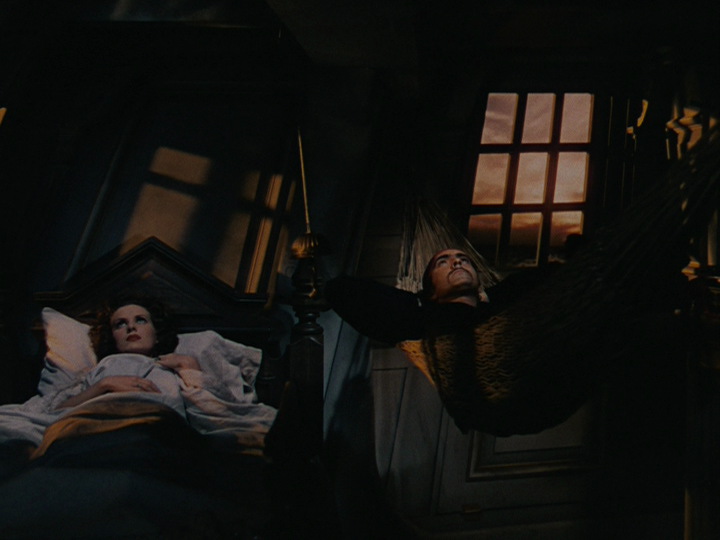
Thanks, Kevin! I was thinking the same thing you were, during that scene in the ship's cabin where Power crawls in bed with O'Hara. "How'd the censors let that through?" I mean, Power had his shirt off (Shock! Horror!) Maybe they wrote the film off as a light-hearted matinee adventure and so weren't watching as closely as usual. Not likely, perhaps, but how else to explain the lapse? There are a number of other things that the scriptwriters snuck through, including some pointed references to what those nasty pirates got up to with the women they captured when they ransacked a port.
Great write-up Jeff on a film that positively glows. I adore swashbucklers and always have, they seem to speak to that little kid inside me. I once toyed with the idea of running a blog dedicated solely to the sub-genre but dropped it in the end. there are so many highly enjoyable swashbucklers out there though - they may not be great art but they are just such tremendous fun.
Jeff
2/22/2013 10:24:53 am
Cheers, Colin! Interesting to hear that you once mooted a swashbuckler specific blog. I would've liked to have seen that, but think in hindsight your blog's current direction has far more scope and range (the western being an infinitely more varied genre). 2/22/2013 06:30:20 am
Admittedly not the biggest Tyrone Power fan nor am I big on the genre but that said this film ranks up there with the best (for me, it's CAPTAIN BLOOD) and O'Hara was just plain beautiful. Terrific write up Jeff.
Jeff
2/22/2013 10:27:17 am
Thanks very much, John! I'm fond of CAPTAIN BLOOD too (any time you put Basil Rathbone and Errol Flynn together in a swashbuckler, it's gold). The pirate film is not my favorite flavor of swashbuckler, but there were several good ones made back in the day. It's hard to beat the sight of Maureen O'Hara in Technicolor. Jeff, I love a good swashbuckler, too, and you picked a fine one. I think it ranks near THE MARK OF ZORRO as one of Tyrone Powers' most flat-out entertaining films. Maureen O'Hara is fabulous; I also loved her as the lady pirate in AGAINST ALL FLAGS. Visually, THE BLACK SWAN a stunning film and your colorful photos provide ample evidence of that. By the way, the source novel was written by Rafael Sabatini, a master of historical fiction, who also penned CAPTAIN BLOOD, SCARAMOUCHE, and THE SEA HAWK (though the plot is different from Errol's movie). Finally, I am also a proud owner of "Cads and Cavaliers," a film book that's great fun.
Jeff
2/22/2013 10:31:56 am
Hey Rick! Somehow I neglected to mention the Sabatini connection, which was dumb of me. Fixed now, thanks for the reminder. According to Belmer's commentary, very little of Sabatini's original novel made it intact to the film screenplay, other than the basic set-up, location and some character names. I agree with you re: O'Hara; she always brought so much spark to these colorful adventure films. Nice to hear of another fan of CADS AND CAVALIERS. It took me a long while to track down a musty old copy, but I'm very glad I did, as it's a terrific book. 2/22/2013 09:30:25 am
Loved your post - really beautifully done. I agree that these films are such grand fun - a feast for the eyes as well as the heart.
Jeff
2/22/2013 10:33:14 am
That's very kind of you, Flick Chick! This movie (and others of its ilk) are indeed visual feasts. THE ADVENTURES OF ROBIN HOOD is another one that just knocks your socks off with its use of bold Technicolor. 2/22/2013 02:58:27 pm
Jeff, you nailed it when practically the first thing you mentioned was the beauty of this film. The swashbuckler is a genre I became interested in only recently. I picked up "The Mark of Zorro" and was so impressed I watched "The Black Swan" right afterward. I agree with you (and others) that it's not the classic "Zorro" is, and also, unlike "Zorro," I couldn't help envisioning Errol Flynn in the lead role while watching. Still, an ejoyable and great-looking movie and a good representative of its genre, all of which I think you conveyed nicely.
Jeff
2/23/2013 12:32:11 pm
Thanks for the comment, R.D.! Nice to hear that you've been dipping your toe into the swashbucker waters recently. THE MARK OF ZORRO is a perfect place to start. I think THE BLACK SWAN with Errol Flynn in the lead would have been wonderful, but I'm glad Power had a chance to play a pirate at least once in his career (and this would have been old hat for Errol). I think Power acquits himself very well.
Kimberly Wilson
2/22/2013 04:19:53 pm
Love the images you chose for this! Technicolor can make a lesser film seem better than it is. O'Hara and Power have great chemistry in this! Nice post.
Jeff
2/23/2013 12:37:30 pm
Thank you, Kimberly! The beautiful Technicolor does indeed kick this one up a notch, no doubt. O'Hara talks about Leon Shamroy's careful use of lighting on the commentary track, in contrast to her previous Technicolor film, TO THE SHORES OF TRIPOLI, on which she said she was nearly blinded by all the harsh lighting used.
Jeff, I think this review is my fave Stalking Moon post. I'm glad you chose this film for the blogathon; it would have been a shame if it had not been included.
Jeff
2/23/2013 12:49:50 pm
Hey Ruth!
What a fun review! I love getting a glimpse into how some of our favorite films are made and you've added so much interesting 'behind the scenes' info here on The Black Swan. 20th Century Fox created something special here as you've shown.
Jeff
2/23/2013 12:43:43 pm
Hi Page! Thanks so much for the nice comments! 2/23/2013 10:33:27 am
Great review and awesome stills you have included for the blogathon!
Jeff
2/23/2013 12:46:01 pm
Thanks a bunch, Patti! Interesting to hear that THE BLACK SWAN didn't do it for you. Is the genre not your cup of tea, or are you not a fan of Tyrone Power? I'm curious as to what put you off it. I know the feeling though, as there are plenty of films others strongly recommend that don't float my boat. I do hope you decide to give it another try someday. 2/23/2013 09:02:44 pm
Actually, Jeff, I adore Ty Power. He's one of my to 10 guys. And Maureen is in my top 15 of gals. I also really like Thomas Mitchell. I haven't seen a whole lot of that genre, but the films I have seen (Mark of Zorro, Prisoner of Zenda), I have enjoyed. SO...there is no reason I shouldn't like "The Black Swan." Maybe it was my mood on the day I happened to watch it! I do intend to give it another try!
Rod Croft
2/24/2013 06:37:57 am
Jeff,
Jeff
2/24/2013 08:35:38 pm
Thank you most kindly, Rod! That "Family Night" local theater classic movie you mention showing sounds great. I managed to catch a few of those kinds of special screenings back when I lived in Seattle, but they're few and far between here in Osaka. At least now with a big screen TV and a DVD/BD player, I can have my own home theater showings at least...but nothing compares to the real cinema experience. You've really captured the beauty of the film (and the actors) with those amazing stills. I really love that one of O'Hara next to the pillars; definitely one to make you catch your breath. I also really love how Shamroy uses those blue shadows. It sort of reminds me of his work in <i>Leave Her to Heaven</i>. It's a real shame that the swashbuckler is for the most part, a vanished genre. You could argue that superhero films have sort of taken its place but for my money, a lot of the humor, pacing, and sex appeal of those old films has been lost. Fantastic review!
Jeff
2/24/2013 08:40:23 pm
Thank you for the comments, Aubyn! Isn't that shot of O'Hara and the pillars great? Shamroy was an obvious master of the Technicolor camera, like Jack Cardiff. LEAVE HER TO HEAVEN is another gorgeous-looking film. 2/24/2013 11:09:18 pm
Great write-up! Sadly, I have not seen this one, but now I want to based upon your piece. I agree that Tyrone Power sometimes doesn't receive the credit he deserves. He was a solid and appealing actor, so I am looking forward to seeing this one. Having the lovely Maureen O'Hara in this one makes it a must in my book :)
Jeff
2/25/2013 10:22:56 pm
Classicfilmboy, thanks for your remarks! I'm glad to hear I might have steered you to THE BLACK SWAN. Good to see another fan of the somewhat underrated Tyrone Power. I think "solid and appealing" is a fair description of his talents and screen presence. I quite like a good swashbuckling action film, so I'd give this a watch Jeff. Great review and photos, wow what a hunk Tyrone Power was, such eye candy :D The costume looks gorgeous too, I've been learning about Edith Head the past week for an Oscar blogathon, I adore the costumes of Classic Hollywood!
Jeff
2/28/2013 10:01:53 pm
Hi Ruth, thanks for the comment! Yep, Tyrone Power was a handsome fellow, no doubt. I hope you do check out THE BLACK SWAN (and if you want some more good Power action, THE MARK OF ZORRO is a good choice.) Power also made a whole slew of romantic melodramas in his career, and has never been short of female fans. ;) You're right about the costumes in this...the Hollywood studios knew their way around a costume drama.
Rahul Lobo
7/11/2013 03:30:12 am
Excellent post. Wish present day movies paid as much attention to color. Its as if the movie makers had a better understanding of it during the early years. That surreal, magical quality is missing. Hopefully it will come back.
Jeff
11/13/2014 11:48:03 am
Sorry for the late reply, Rahul! I completely agreeb - old Hollywood really knew how to use color. I grow tired of the washed-out, gray/blue palette so common in today's movies. 11/11/2014 12:01:29 am
Great review!
Jeff
11/13/2014 11:48:58 am
Thank you for the kind words and the link, danyulengelke - much appreciated! Leave a Reply. |
Videophilia!
Opinionated ramblings about new and old movies (mostly old, as that's the way I like 'em!) 
Blogs of Note
Stuart Galbraith IV's World Cinema Paradise
Movie Morlocks (TCM's Classic Movie Blog) 50 Westerns from the 50s Riding the High Country Sweet Freedom Tipping My Fedora Thrilling Days of Yesteryear Silver Screenings Laura's Miscellaneous Musings Classic TV and Film Cafe Just a Cineast She Blogged By Night Chess, Comics, Crosswords, Books, Music, Cinema Out of the Past - A Classic Film Blog Pretty Sinister Books They Don't Make 'Em Like They Used To In So Many Words... Greenbriar Picture Shows Flix Chatter My Love of Old Hollywood Tales of the Easily Distracted Another Old Movie Blog Lasso the Movies Kevin's Movie Corner Films From Beyond the Time Barrier Carole & Co. Rupert Pupkin Speaks Caftan Woman Vienna's Classic Hollywood The Lady Eve's Reel Life ClassicBecky's Brain Food 
Hey!
Be sure to subscribe to the RSS feed below, to be informed of new postings! 
Categories
All
Archives
September 2015
|
 RSS Feed
